Mature organizations have a senior leader everyone trusts. That is exactly the problem.
By the time an organization reaches maturity — a stable budget, a long-tenured leader, a board that has served together for years — it has usually developed a quiet, unspoken crisis plan. The plan is: the senior pastor will handle it. Or the executive director. Or the founder who is still in the building.
This is a particular kind of mistake. It confuses moral authority with operational capacity.
Senior leaders carry the institution’s spiritual authority. They are rarely the right person to monitor social media at 2 a.m., draft a statement while on the phone with the denomination’s legal office, and coordinate the review of that statement before it goes out. Mature organizations do not lack leaders. They lack teams — working units with defined roles, authority, and accountability that activate when the crisis hits.
A routine afternoon
You never know when an ordinary day will turn into a legal standoff. I once had to field an urgent call from an attorney representing a former pastor who had been accused of fraudulently registering a business name and signing vendor contracts under it. The lawyer was demanding board-voted documents from the new pastor right then and there.
I had to step in, firmly refer the attorney to the county courthouse for public records, and instruct him that all further legal inquiries had to go through our legal counsel. It was exactly the kind of moment that reveals whether an organization has a team or a hero. A hero improvises under pressure and hopes. A team knows its limits and knows who the legal liaison is before the phone rings.
The Crisis Communication Team
A Crisis Communication Team is not a committee that meets to admire the senior leader’s plan. Every member has a specific job that no one else is doing. For most mid-sized organizations, those jobs are:
Crisis Director — the single point of decision authority. Convenes the team, signs off on statements, makes the go/no-go calls.
Designated Spokesperson — the single public voice. Trained, calm, credible, available. Not necessarily the Crisis Director; sometimes the wisest move is to keep the senior leader away from the cameras.
Communication Lead — drafts statements, manages the press list, coordinates internal messaging.
Social Media Lead — monitors platforms in real time, posts approved content, flags trends.
Legal Liaison — reviews statements before release; advises on disclosure obligations.
Pastoral Care Coordinator — ensures victims, families, staff, and community receive direct human support. The institutional conscience of the team.
Documentation Lead — keeps the crisis log: every action, decision, and communication, with timestamps. Invisible until the after-action review, when it is invaluable.
Board Liaison — keeps governance informed at the right level without dragging the board into operational decisions it should not be making.
Denominational or Network Liaison — coordinates with the wider body. In connectional systems, this role is non-negotiable for any serious crisis.
Smaller organizations combine roles. Larger ones multiply them. What matters is that every function is owned.
Choose composure over credentials
The temptation in a mature organization is to give every job to the most professionally credentialed person available. Resist it. Crisis work is performed under acute stress, often in the middle of the night, often when emotions in the room are running high. The right people are not necessarily the most polished. They are the most composed, the most spiritually grounded, and the most reliable.
Look for spiritual maturity that will hold under pressure. Look for composure tested in scenario exercises — not assumed from a résumé or a pulpit performance. Look for diversity of perspective — age, gender, ethnicity, lay and clergy — because a team that all thinks alike will all miss the same things. Look for availability, including evenings, weekends, and the day you gather for worship. Crises do not respect the calendar.
The question mature organizations do not want to ask
Here is where maturity becomes a liability. Define, in writing, before the crisis: who can authorize a public statement? A press conference? An independent investigation? An emergency expenditure? These authorities should be located clearly enough that no one wastes time looking for permission at 2 a.m.
And then ask the question that long-tenured, well-loved leadership makes uncomfortable: What happens when the senior decision-maker is unavailable — or is the subject of the crisis?
The board chair should have standing authority to convene the team and act on behalf of the institution if the senior leader is implicated. This is not paranoia. It is prudence. The organizations most damaged by leadership scandal are almost always the ones where no one had the authority — or the courage — to act without the leader’s permission, because the leader had never been anything but trustworthy.
Build the escalation path while you still trust everyone. That is the only time it can be built.
Step 5: Practice
A team that has never trained together will not perform together. Tabletop exercises are the single highest-leverage investment a mature organization can make in its readiness. They do not require expensive consultants. They require a willing team, a realistic scenario, and an afternoon.
A workable annual rhythm: January, review the risk assessment and update the roster. March: run a tabletop on a financial or misconduct scenario. June, run a digital simulation on a social media escalation. September: review and update the holding statements. December, conduct the year-end readiness audit.
Heroes do not save institutions in crisis. Teams do. Build yours before you need it. Train it on a cadence. Clarify authority in writing. And within the next 30 days, send each person on your team a one-page memo outlining their role, training schedule, and after-hours contact expectations.
If a crisis broke this weekend, who would activate your team? Do they know they would?
This article draws on Chapter 3 of my book, Crisis, What Crisis? A Guide to Crisis Communication for Churches and Non-Profits. Next in this series: why leadership transitions are when your crisis plan quietly expires. To get the book, visit: https://books.by/drkenn-dixon
Crisis adaptation, digital ministry team building, and infrastructure planning at the Texas Conference of Seventh-day Adventists
Dr. Kenn Dixon, LSSGB, APR Former Vice President for Communication and Public Relations Texas Conference of Seventh-day Adventists
THE CENTRAL CASE
A modest room became mission infrastructure because the team treated technology as a way to preserve connection when physical gathering was disrupted
Publicly documented milestones through 2026 with internal data needs identified
Executive Summary
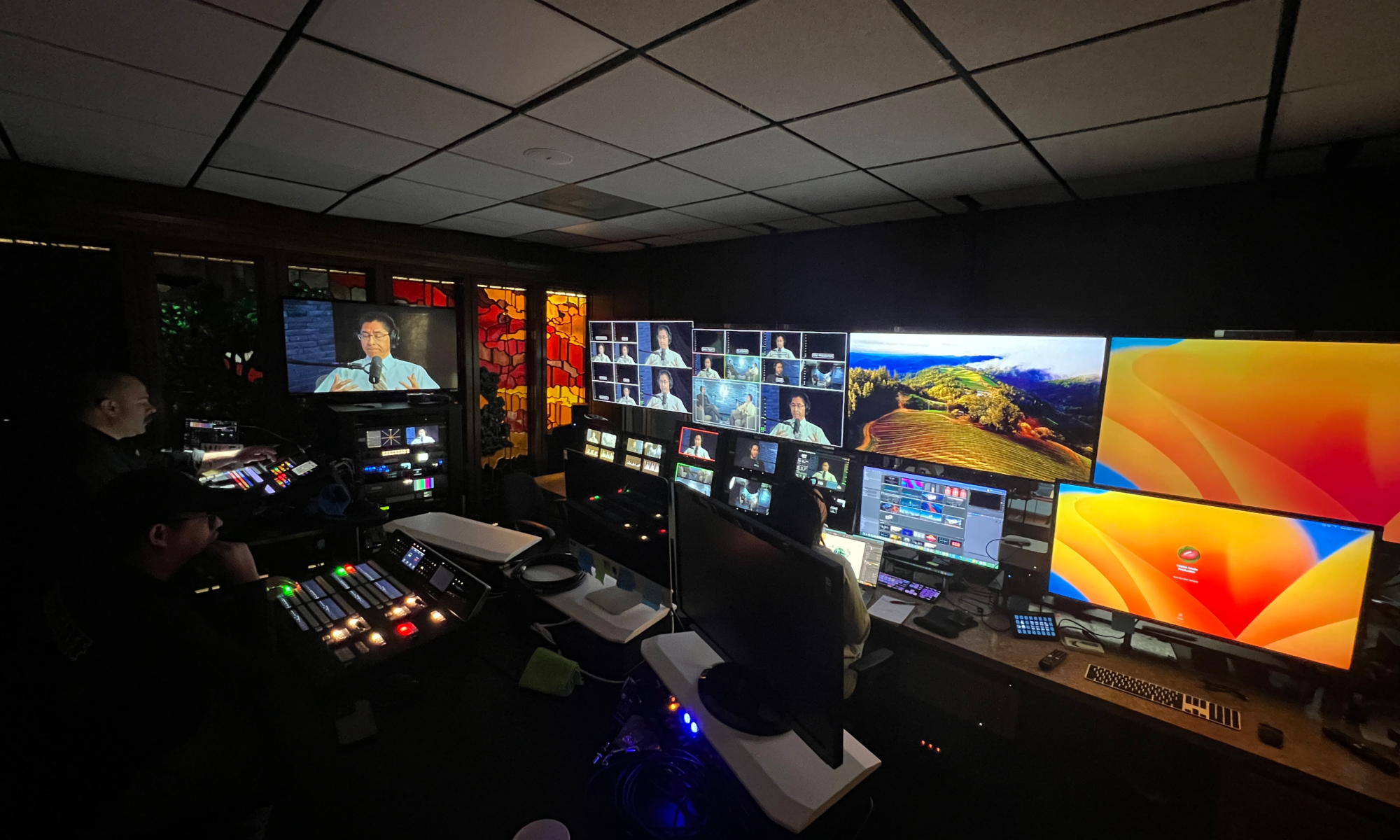
The Texas Conference studio story is more than a pandemic success story; it is an example of preparation meeting disruption. When I began serving the Texas Conference in 2019, I believed every conference needed a bilingual media studio for the digital age. That same year, we established one. My team and I were later credited with transforming the office worship area into a studio that, by 2022, was broadcasting beyond Texas to audiences around the world.
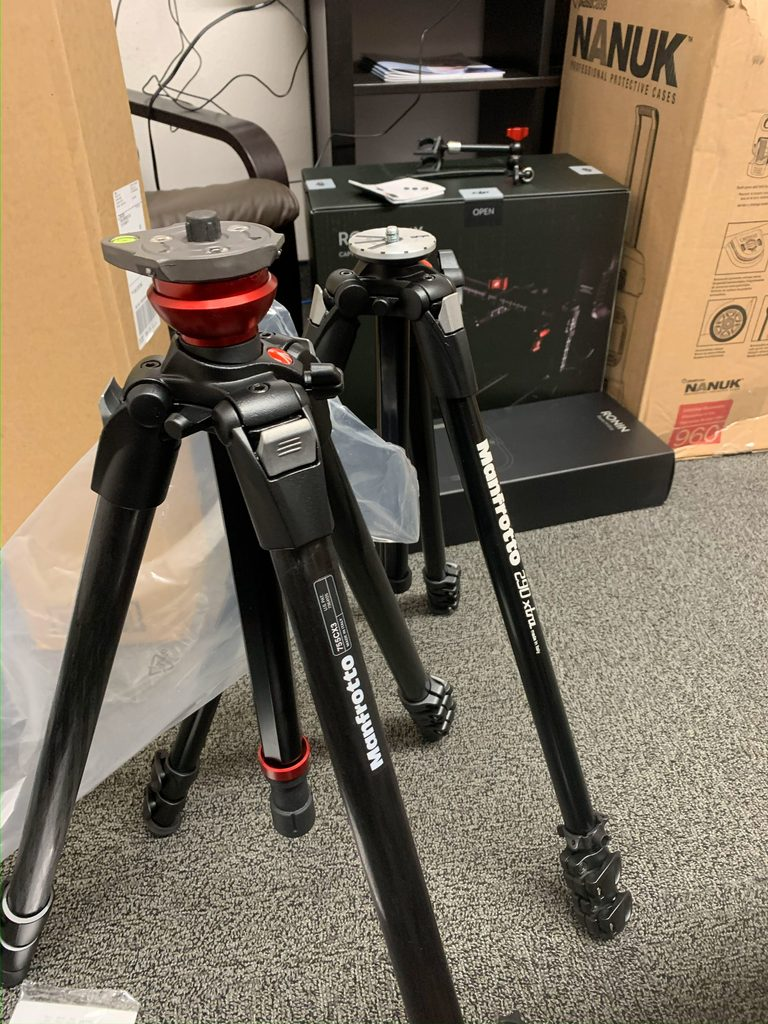
The first Shipment of equipment for the new digital content creation for the Texas Conference prior to COVID-19. (2019)
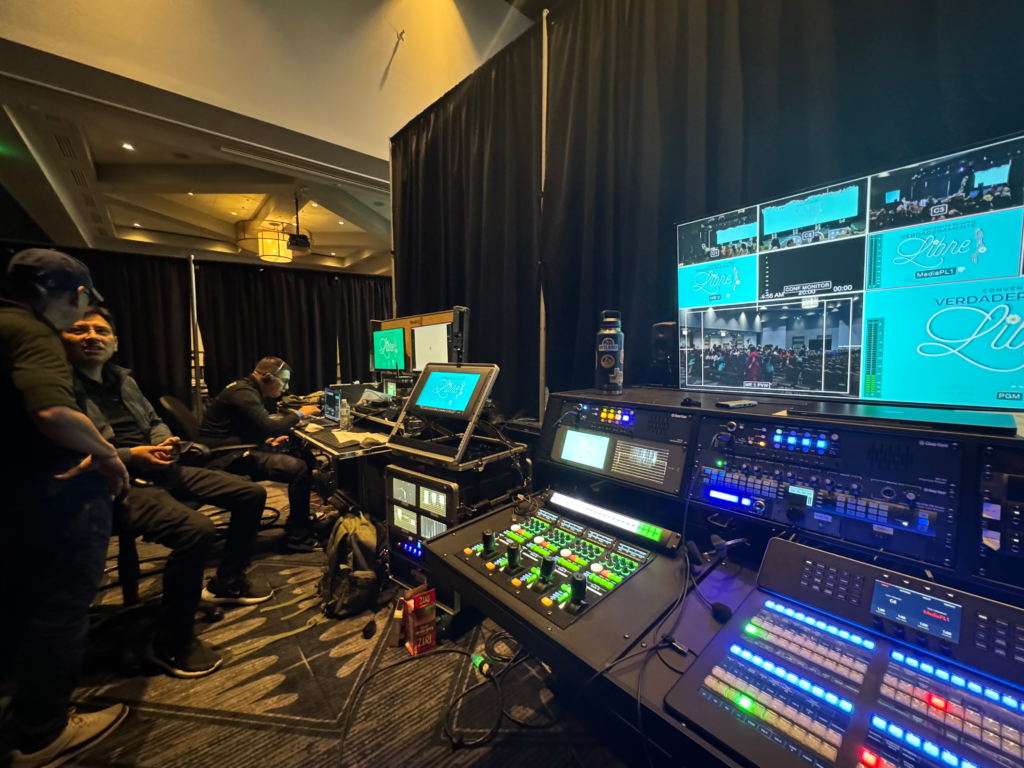
COVID-19 changed the pace and purpose of that investment. As churches closed and online viewing became essential, the studio moved from a developing communication asset to mission-critical ministry infrastructure. Working with a growing team, we created a weekly online church service to give members another worship option. The work expanded in English and Spanish, supported departments and local congregations, and eventually moved beyond the room through live event and mobile production. n
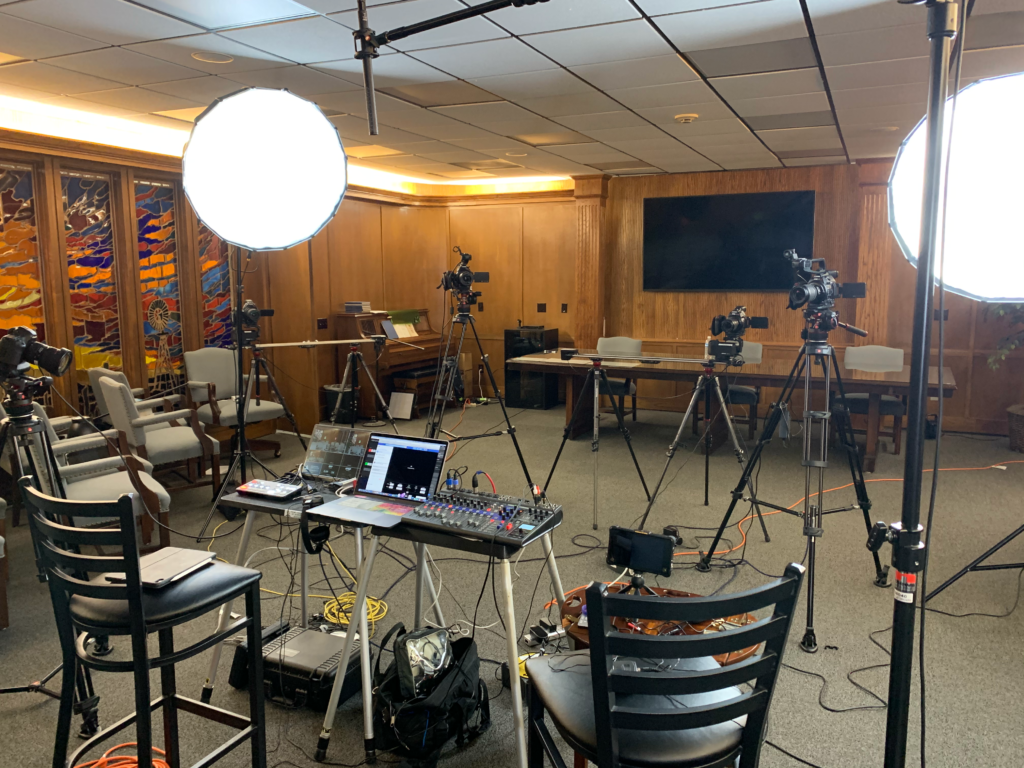
The beginning of the vision in 2020.
The transformation was physical, but the deeper change was organizational. We had to build a repeatable production rhythm, recruit people with complementary skills, define standards, learn which workflows could survive weekly pressure, and think beyond a single platform. The studio became a service model: production, training, event support, church assistance, and digital distribution working together.
The strongest lesson is that crisis adaptation should create durable capacity. The churches reopened, but the need for communication did not disappear. The studio continued serving ministries, producing English- and Spanish-language content, livestreaming major events, training church communicators, and contributing to a broader digital ecosystem that now reaches mobile, connected-TV, social, and web audiences.
The Personal Starting Point
I have never believed ministry and technology belong in separate rooms. Earlier in my career, I taught technology and saw how digital tools could expand the reach of pastoral work. When I joined the Texas Conference in the fall of 2019, I did not see the office worship area only as a room for employees to gather. I saw a space that could be activated to serve churches, schools, departments, and people who might never enter the building.
The original goal was for the Texas Conference to establish a media studio in 2019 capable of producing high-quality content in both English and Spanish. The timing matters. We were building before anyone knew how severely the pandemic would disrupt congregational life. The crisis did not create the vision; it tested whether that vision could become operational quickly enough to make a difference.
The Leadership Question
How do you convert a familiar internal space into a reliable ministry platform while conditions are changing? Our answer was not one piece of equipment. It was space, people, process, standards, language access, and distribution.
The Timeline from Room to Platform
Period
Documented development
Strategic meaning
2019
I joined the Conference in the fall, and soon after, I presented to the Executive Committee the need for content creation. The Conference established a media studio for high-quality English- and Spanish-language content.
The organization entered the crisis with an emerging production capability rather than a blank sheet.
March 2020
The COVID response plan anticipated church closure, online viewing, and contingency plans led by Communication and Public Relations.
Digital communication became part of continuity planning and member care.
Pandemic period
We created a weekly online church service when churches closed.
A room and equipment became a recurring pastoral service with a weekly deadline.
By May 2022
The office worship area had been transformed into a studio broadcasting around the world.
The studio moved from local space conversion to a visible institutional capability.
2022 onward
Media production became prominent; staff supported design, livestreamed events, and studio recordings.
The work required a team and cross-functional operating structure, not a single technical specialist.
2023 to 2024
The team received communication awards and offered English- and Spanish-supported workshops on streaming, sound, audience development, strategic communication and presentation tools.
Production knowledge was converted into capacity for local churches.
Later development
The brief identifies mobile broadcasting; off-site livestreaming of camporees and convocations and current multi-camera event production.
The studio became a hub for production beyond its own walls. A Mobile Production Truck and live-onsite complete production capabilities.
What Changed When the Churches Closed
Before COVID, media could still be treated as a program enhancement. Once physical worship was disrupted, communication became part of the ministry’s operating core. The Conference response plan explicitly contemplated church closure, encouraged online viewing, and stated that the Communication and Public Relations department had contingency plans.
The weekly service was our practical response to a pastoral problem: people needed continuity, worship, reliable information, and a sense that the church had not disappeared because the building was closed. That required more than streaming a camera. A weekly service needs speakers, music, scheduling, scripts, graphics, recording, editing, approvals, distribution, and someone accountable for every handoff.
Crisis Speed with Ministry Discipline
The urgency could not become an excuse for carelessness. Broadcasting exposes every weak link at once: audio, lighting, internet, file preparation, speaker readiness, music rights, timing, and follow-up. We learned to think in systems. Later production standards required advance submission, approved formats, 1920 x 1080 video, H.264 compression, 48 kHz audio, speaker lists, and preparation deadlines. Those standards show how an emergency response matured into a controlled production environment.
Building the Team
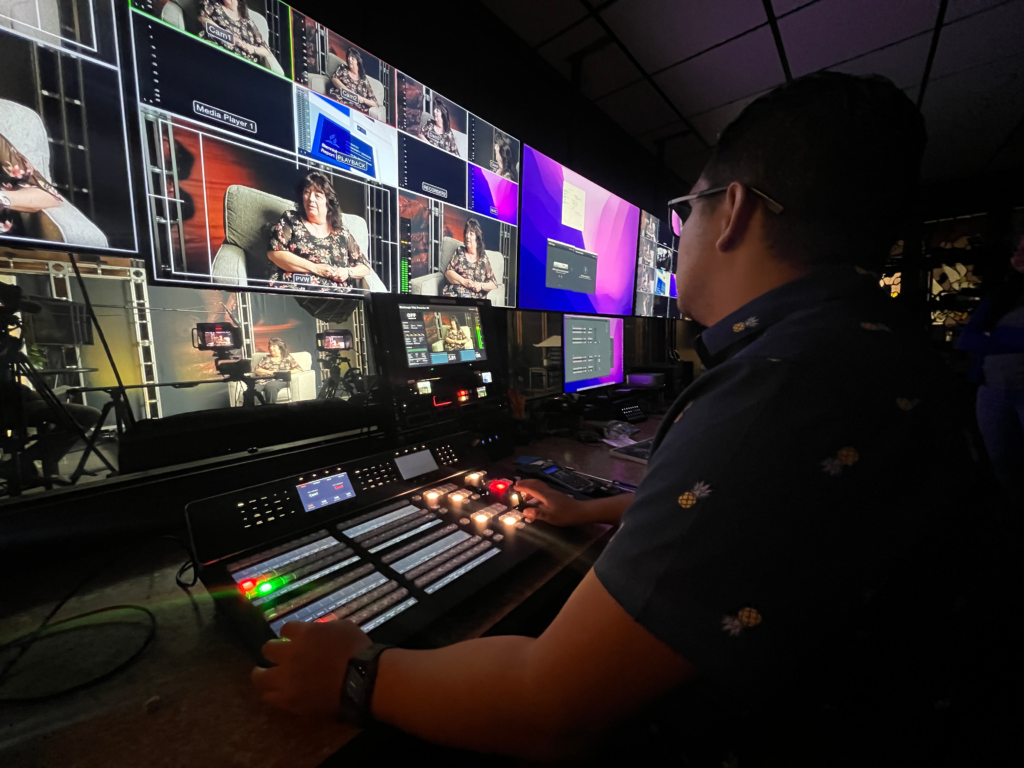
Although the case is personal, it was never a solo effort. A team helped create the weekly online service, turning ideas into a reliable production rhythm through coordination, editorial judgment, and event experience. As media became more central to the organization, the work drew on people with strengths in production, design, pastoral ministry, technology, language, and stage management.
The team later expanded to support graphic design, livestreamed events, studio recordings, and stage management. As it grew, the leadership team brought together theology, audiovisual communication, design, technology, multilingual skills, and disaster-risk training. Other contributors strengthened the work through content development, audio, graphics, production, and distribution. The lasting capability came from combining disciplines that institutions often keep separate.
Building the team Texas Conference needed.
The Team Design Principle
A broadcast ministry should not be built around one person who knows where every cable goes. It needs shared knowledge, documented standards, cross-training, role clarity, and a pipeline for new contributors. The leader’s work is to create an environment in which creative and technical people understand the ministry purpose and ministry leaders respect the production process.
English and Spanish as Infrastructure
The studio was bilingual by design, not as a late translation exercise. In 2019, the vision states that it was established to produce high-quality content in English and Spanish. That choice aligned the production model with the Conference’s actual membership and ministry field.
Language expansion affects more than presenters. It changes scheduling, graphics, editing, channel strategy, captions, promotion, technical support, and the composition of the production team. Later public programs show separate English and Spanish streams, channels, presenters, and workshops. The result was not a single message mechanically duplicated. It was an infrastructure capable of serving distinct audiences with appropriate language and leadership.
From Fixed Studio to Mobile Production
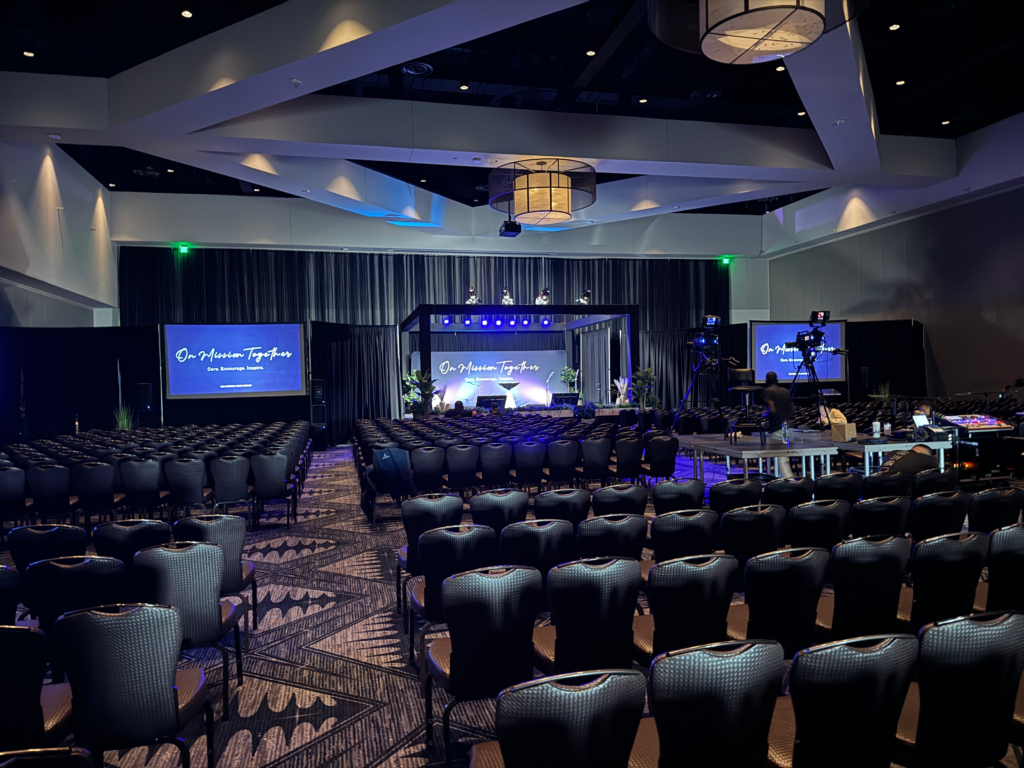
A fixed studio provides consistency, while mobile production extends reach. The expanded vision recognized the need for mobile broadcasting, including livestreams for Adventurer, Master Guide, and Pathfinder camporees, as well as East Texas and Laredo convocations. Today, that work includes multi-camera production and support for major Conference events.
That transition changes the planning model. A studio controls light, acoustics, power, connectivity, and camera positions. A field production inherits the venue’s limitations. Mobile broadcasting therefore requires advance site surveys, network testing, transport and inventory controls, redundant signal paths, setup schedules, weather planning where applicable, local volunteers, and clear authority on production day.
The strategic value is larger than convenience. Mobile capacity allows the production team to bring visibility to ministries and regions instead of requiring every story to come to headquarters. It turns the studio from a room into a networked service.
The Operating Model
Capability
What had to be built
Why it mattered
Space
A worship room adapted for camera positions, lighting, sound, sets, control, and recording
Made recurring production possible without rebuilding every week
Programming
A weekly worship format with speakers, music, graphics, editorial review, and distribution
Turned equipment into a dependable ministry experience
People
Editorial, pastoral, production, design, audio, stage, language, and technical roles
Reduced single-person dependency and improved quality
Standards
Submission deadlines, media specifications, rights management, run sheets, and presenter information
Protected reliability and reduced avoidable production-day risk
Distribution
Web, YouTube, Facebook, English and Spanish channels, apps, and connected devices
Allowed content to meet audiences across platforms
Mobility
Portable production systems, venue planning, connectivity, transport, and redundancy
Extended production to events and communities across the territory
Training
Workshops, technical guidance, recordings, and church support
Moved the Conference from producer to capacity builder
Social Performance from 2021 to 2025
The analytics show that the studio’s expansion was accompanied by substantial social distribution. They do not form one perfectly consistent annual series. Channel portfolios changed, reports cover different time windows, and platform definitions evolved. Read together, however, they show four clear patterns: rapid portfolio growth, video-led reach, increasing value from audience-specific channels, and a continuing need to convert discovery into deeper viewing and interaction.
Period and scope
Reported performance
What it indicates
2021 Six channels Trailing 365 days
28.31K fans, 1.27K net new fans, 50.11K engagements, 1.92M impressions, and 1.23M reach. A 647-post benchmark reported a 2.4% engagement rate.
The crisis-era network reached meaningful scale across institutional, youth, community-service, camp, and church-planting accounts.
2022 YouTube Jan 1 to Dec 1
35.6K views, 142.5K watch minutes, 788 likes, and 266 new subscribers. Twenty-nine Shorts produced 14.8K views; livestreams produced 14.1K views and 10.7K viewing minutes.
Video served both discovery and worship. Shorts widened entry points while the Pathfinder Camporee made live event production the year’s strongest viewing anchor.
2022 to 2023 Eleven channels Apr 9 to Apr 9
37.38K fans, 3.21K net new fans, 98.71K engagements, 3.53M impressions, and 2.27M reach. The dashboard reported fans up 10% and impressions up 6%, but engagements down 23% versus its comparison period.
Distribution kept expanding, but interaction did not rise at the same pace. Scale was no longer the only management question; engagement quality and content relevance mattered more.
2023 sample Facebook Instagram and Twitter Aug 7 to Sep 5
Sixty-two posts generated 1,038 engagements: 474 on Instagram, 464 on Facebook, and 100 on Twitter. The educator-convention story produced 359 engagements across Facebook and Instagram.
Facebook and Instagram generated 90% of measured engagement. Human-centered education content outperformed routine notices and demonstrated the value of adapting one story across channels.
2024 Evidence gap
No standalone 2024 annual report was included. Percentage changes in the 2025 dashboard use an undocumented comparison setting.
A responsible annual trend cannot be reconstructed from the available files. The missing year should remain visible until a native 2024 export is recovered.
2025 campaign Spanish channels Jun 5 to Jun 11
16.01K video views, 6.23K ten-second views, 10.44K viewers, 5.58K repeated views, and 17.71K watch minutes, with no paid views. Adventistas Hispanos de Texas generated 15.94K views.
The campaign produced strong organic discovery and repeat exposure. Nearly all measured views came through the principal Spanish channel, confirming the value of a clear audience home.
Growth with an Efficiency Warning
The six-channel 2021 portfolio and the eleven-channel 2022 to 2023 portfolio are not a strict like-for-like comparison, but their scale is instructive. Reported fans increased from 28.31K to 37.38K, impressions from 1.92 million to 3.53 million, reach from 1.23 million to 2.27 million, and engagements from 50.11K to 98.71K. Those changes represent approximate increases of 32%, 84%, 85%, and 97%, respectively.
Efficiency moved in the opposite direction. The content benchmark engagement rate was 2.4% in the 2021 report and 1.01% in the 2022 to 2023 report. Channel expansion, different account mixes, and reporting changes prevent a clean causal conclusion, but the direction is useful: a larger network created more exposure while making it harder to sustain the same interaction rate. This was a signal to manage for audience response, not volume alone.
A Portfolio Rather Than a Single Account
The 2022 to 2023 dashboard shows why the work should be understood as a network. Young Texas Adventist generated 35.2K engagements and 667.02K reach, exceeding the main Texas Conference account’s 18.41K engagements and 500.39K reach despite having fewer fans. Adventistas Hispanos de Texas added 14.58K engagements and 276.43K reach, while the president’s channel generated 13.51K engagements and 173.42K reach. Audience-specific channels were not secondary distribution outlets; they were central drivers of participation.
Organic average daily reach increased 5% in the 2022 to 2023 dashboard while paid average reach decreased 20%. That pattern suggests the portfolio retained an organic base even as paid contribution softened. It also reinforces the value of relevant communities, recognizable voices, and event-driven content.
Video Created Multiple Paths into the Ministry
YouTube’s 2022 report shows three different video behaviors. The channel accumulated 35.6K total views and 142.5K watch minutes, equal to roughly four minutes watched per view across the channel. Shorts supplied 14.8K views through 29 uploads, while livestreams supplied 14.1K views. The most-watched livestream and the top three videos were connected to the Texas Pathfinder Camporee. The lesson was not to choose between short and long video. Short clips created discovery; live events created shared experience and sustained attention.
The 2025 Spanish Campaign Shows Both Reach and Friction
The seven-day report is the strongest campaign-specific evidence in the file set. Its overview recorded 16.01K video views, 10.44K viewers, 5.58K repeated views, and 17.71K watch minutes, all without paid video views. Adventistas Hispanos de Texas accounted for approximately 99.6% of the reported views. Repeated views equaled about 35% of total views, showing that the campaign generated return exposure rather than only one-time contact.
The same report also shows where packaging needed to improve. Ten-second views were 6.23K, about 39% of total views. A separately filtered post-performance panel reported a 28.48% view rate and a 0.86% completion rate. Those figures should not be combined with the overview totals because the panels use different scopes, but the strategic implication is consistent: the campaign was effective at earning attention, while full completion was difficult. Individual recap clips posted completion rates above 15% and sometimes above 20%, while two full live programs showed completion below 2%. Live worship built presence and watch time; edited summaries created a more accessible path for later viewers.
What the Numbers Changed for Me
The data confirmed that the studio had become more than a production room. It was feeding a connected portfolio of communities, formats, languages, and events. It also challenged a common communications assumption: more reach does not automatically mean more relationship. The next stage of leadership was to ask which content invited people to stay, respond, return, and take a meaningful next step.
Evidence Completeness and Remaining Gaps
The analytics establish a credible quantitative performance layer, but they still do not provide a uniform 2021 to 2025 annual dataset. The visible boundaries are:
Growth versus direct comparison. The portfolio grew from six channels in 2021 to eleven in 2022–2023. Fans, reach, impressions, and engagements increased, but this is not a strict like-for-like comparison.
Annual performance versus snapshots. The sources cover different periods: a trailing year in 2021, eleven months of YouTube in 2022, a one-year portfolio ending in 2023, a one-month 2023 sample, and a seven-day 2025 campaign.
Different metric definitions. Reach, impressions, potential impressions, views, viewers, autoplays, ten-second views, and completion rates measure different behaviors. They should not be combined as though they were interchangeable.
Conflicting dashboard scopes. The 2025 overview reports 16.01K video views, while a filtered performance panel reports 6.49K. Both may be correct for their respective filters, but they cannot be added or directly compared.
Reach versus relationship. The data shows exposure and interaction, but it does not prove spiritual growth, trust, church attendance, baptisms, or other ministry outcomes. However, giving increased from $50 million to $70 million between 2020 and 2024, supported by the Advent Giving online campaign. That growth offered a revealing measure and reinforced the importance of operating effectively in the digital space.
Performance versus attribution. The numbers show growth during the studio’s development, but they do not prove that the studio alone caused it. Events, content strategy, channel expansion, audience interest, and platform algorithms also played a role. During this same period, the Conference’s membership continued growing, surpassing 70,000 by 2026. That growth began during the studio’s founding years and the expansion of its online presence.
Audience activity versus church participation. Analytics reveal viewing behavior but not how many churches, pastors, departments, musicians, or volunteers participated in producing the content.
Operational impact versus financial return. The initiative began with a $50,000 equipment budget in 2019 and grew into more than $1 million in spending on mobile production capacity and studio upgrades by 2025. Those costs were partly offset by contracted production work for other conferences, events, and ministries, though a complete financial return analysis would still require detailed records of equipment, staffing time, software, training, revenue, and cost per viewer.
Based on 184,980 video views recorded during the 2022–2023 reporting period, an estimated annual production investment of $40,000 to $75,000 would result in a cost per view of approximately $0.22 to $0.41. For the seven-day 2025 campaign, 16,010 views would translate to about $0.31 per view on a $5,000 budget or $0.62 per view on a $10,000 budget. These estimates suggest strong digital efficiency, but the final calculation should include personnel, software, promotion, and production costs, and measure deeper outcomes such as watch time, participation, and ministry engagement.
The studio enabled substantial growth in digital distribution, especially through video, audience-specific channels, and Spanish-language programming. The available data demonstrates reach and engagement, but additional records are required to establish consistent annual trends, causal impact, financial efficiency, and ministry outcomes.
Lessons from Iteration
The pandemic launch was not perfect, but the circumstances were not normal either. The studio was a successful experiment, but its story should not be reduced to a polished success myth. Every weekly production involved tests, mistakes, and abandoned approaches. The responsible next step is to recover those lessons through run sheets, staff interviews, analytics, equipment logs, and post-production notes.
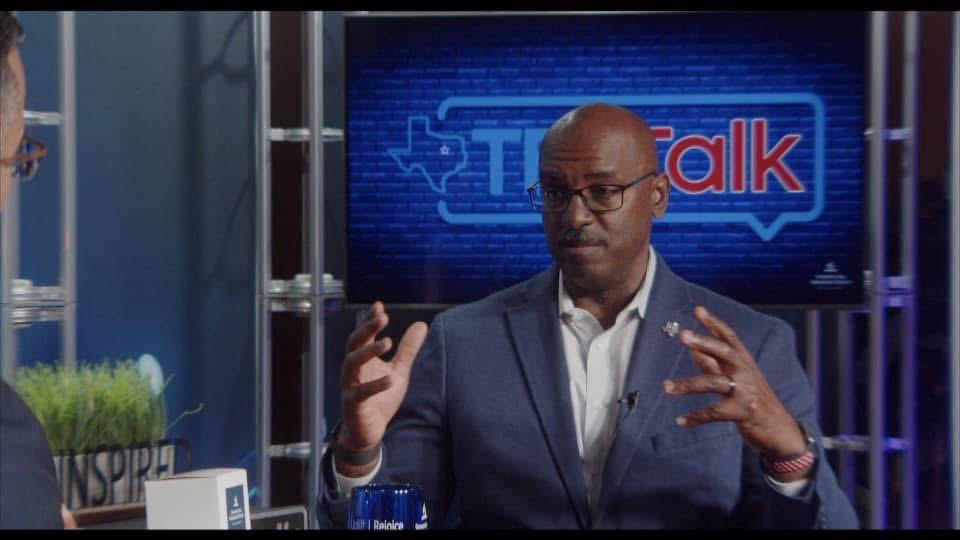
One later example of visible iteration is TexTalk. After audience requests for shorter segments, the team changed the set, refreshed the identity, and used a 15-minute timer to control length. That example reinforces a broader principle: production quality is not only technical quality. It is also the discipline to listen, shorten, simplify, and redesign when the audience experience calls for it.
Questions Worth Recovering for Future Project Lessons
While deeply grateful for the steadfast support of leadership, staff, and local congregations, true growth requires honest reflection. Distance and hindsight now highlight several critical questions that should have been addressed earlier:
What failed under weekly pressure? Identify audio, lighting, connectivity, scheduling, file transfer, and approval problems that recur.
What was overbuilt or underused? Compare purchased capability with actual production demand and staff capacity.
What formats audiences rejected? Look for low retention, weak repeat viewing, comments, and programs that ended early.
What depended on one person? Find tasks that stalled during absence and document how knowledge was transferred.
What should never be repeated? Capture safety, copyright, data, pastoral-care, or reputational risks exposed by early experiments.
Leadership Lessons
Prepare before the crisis. The 2019 investment mattered because capability existed before closures made it essential.
Define the ministry problem first. The goal was continuity, connection, worship, and service, not possession of impressive equipment.
Build a system rather than a room. Space without programming, people, standards, and distribution is only a decorated facility.
Design for the actual audience. English and Spanish production should shape staffing and workflows from the beginning.
Move knowledge outward. Training local communicators multiplies capacity beyond what the central team can produce.
Let emergency capacity become permanent value. The best crisis adaptation leaves the organization stronger after the emergency ends.
Conclusion
The worship room became a broadcast studio because the team saw a room as a resource, media as ministry, and crisis as a call to serve. COVID accelerated the work, but preparation made acceleration possible. The weekly service created connection when doors were closed. Bilingual production widened access. Team development turned individual skill into institutional capacity. Mobile broadcasting carried the work beyond headquarters.
What began as adaptation became infrastructure. That is the professional lesson. The personal lesson is equally important: leadership in disruption is not about predicting every need. It is the willingness to listen, learn quickly, gather capable people, establish discipline, and keep the mission clearer than the technology.
The lasting achievement was not the conversion of one room. It was the creation of a production culture capable of helping ministry happen wherever the audience happened to be.
Source Notes
Texas Conference. The Cycling Pastor. Documents Kenn Dixon’s fall 2019 arrival, the worship-area transformation, worldwide broadcasting, and pandemic-era use of media and technology.
Texas Conference. Reaching a Broader Audience with the Good News. Documents the 2019 studio establishment, English and Spanish production, broad departmental use, and livestreaming of major events.
Texas Conference. Churches COVID-19 FAQ. Documents the closure stages, online-viewing response, and Communication and Public Relations contingency planning.
Texas Conference. Communication Workshop. Documents the 2024 training agenda on streaming, sound, audience development, graphics, and English and Spanish support.
Texas Conference. Digital Communication and Production. Documents the current multi-camera, live-broadcast, event-production, church-support, training, and platform-development capabilities.
Evidence note. Audience totals, participating-church counts, attendance records, equipment costs, mobile-system specifications, and failed experiments were not located in the public sources reviewed. This case labels them as internal verification needs rather than estimating or inventing them.
The growth years are when organizations are busiest — and when the risk map they never drew starts to matter.
“Why plan for what God may not allow?” I have heard some version of this from sincere leaders in growing organizations for twenty years. It sounds spiritual. It is profoundly unbiblical. Here is the theology of preparedness — and the one document your board should produce this year.
Growth is intoxicating. New members, new programs, new staff, a building campaign, a second campus, a grant that doubles the budget. The growth years are when leaders are most energized, most stretched, and most likely to say: “We’ll get to the crisis plan when things settle down.”
Things do not settle down. And growth does not reduce risk. It multiplies the surface area on which risk can land — more people, more money, more data, more programs for children, more public visibility. The organization that was too small to have a crisis plan in year two is, by year six, too big not to.
The theology of preparedness
There is a strain of piety, found in many of our churches and mission organizations, that treats preparation as a failure of faith. “Why plan for what God may not allow?” “Why imagine the worst?” “Don’t we trust the Lord to handle whatever comes?”
These questions sound spiritual. They are profoundly unbiblical.
The same Bible that calls us to trust God also celebrates Joseph for storing grain during the seven fat years for the seven lean years to come. The same Jesus who told His disciples not to worry about tomorrow also told the parable of the ten virgins — five wise, five foolish — and the difference between them was preparation. The faithful steward is precisely the one who has counted the cost, who has built on rock and not sand, who has trimmed the lamp and laid in the oil.
Faith and preparation are not opposites. They are companions. Crisis preparation is not the church’s hedge against God’s absence. It is the church’s offering to a God who gifted it with foresight, intelligence, and the capacity to plan.
That reframe matters in the growth years because growth is precisely the season of “fat years.” It is when the grain is available for storage. The leader who waits for the lean years to begin preparing has misread the story.
Step 1: Identify — imagine the harm in detail
The first step of the 5-Step Plan is Identify. Before you can build a team or write a template, you must know what you are preparing for. Risk assessment is the act of imagining, in detail and without flinching, the specific ways your ministry could be wounded.
Begin with an inventory of what you have that could be damaged or lost:
People — staff, volunteers, members, and especially children and other vulnerable populations.
Property — buildings, vehicles, equipment.
Finances — bank accounts, restricted funds, donor relationships, ongoing income streams.
Data — member records, financial systems, children’s ministry registrations, donor information.
Mission and brand — the reputation of the institution and the credibility of its message.
Relationships — denominational standing, community partnerships, media relationships.
Against each asset, list the realistic threats. Then plot each risk on a simple probability-and-impact matrix. A risk that is highly probable and highly impactful — financial misconduct in a growing organization that still runs on single signatures, for instance — is your top priority. A risk that is improbable but catastrophic — a fire, an active threat — still requires planning, but on a different cadence.
The matrix is not a math exercise. It is a way of forcing leadership to prioritize honestly. And growing organizations, in my experience, have a specific blind spot: they under-rate the risks that come with the very things they are proud of. The new youth program. The new online giving platform. The new building with its new insurance obligations. Growth is where the unassessed risk lives.
The readiness audit
Once you have mapped your risks, ask whether you are ready. Take these ten questions to your board at its next meeting and score yourselves honestly:
Do you have a designated crisis communication spokesperson?
Have you conducted crisis scenario planning in the last twelve months?
Do you have pre-approved holding statement templates?
Is your leadership team trained in media relations?
Do you have an up-to-date stakeholder contact database?
Are your social media accounts secured and access-controlled?
Does your board have a crisis response protocol?
Have you reviewed your legal exposure with counsel in the last year?
Do your staff know whom to contact first if a crisis begins?
Have you identified mandatory reporters and trained them in their obligations?
Most ministries discover they cannot answer “yes” to half of these. That is normal. It is also a starting point. The audit’s purpose is not to grade you. It is to give you a clear set of next actions.
The single most important document your board can produce this year
Compile what you have learned into one page: a Crisis Readiness Profile. The format matters less than the discipline of producing it. It should include your top five to eight risks, ranked; a red-yellow-green readiness score for each; the specific gaps; your priority actions with target dates; and the named owner of each action.
Review it annually. Review it again after any significant change. Keep it in two places — a secure shared drive the crisis team can reach, and a physical copy in the senior leader’s office.
I learned the value of this discipline as Director of Integrated Marketing and Public Relations years ago. We drafted a detailed exercise in which former members of the basketball team, the choir, and the band took to social media to accuse their leaders of misconduct, sparking rumors of a cover-up. By mapping that scenario in advance, we were able to weigh the unintended consequences of our options — whether an awareness campaign would look like a distraction, whether a firm policy statement might invite false claims — before anything had happened. Walking through that dark “what if” prepared us for the realities of digital-age accusations before they materialized.
A worked scenario, even a brief one, is worth ten generic plans. When the crisis arrives, the difference between a team that has rehearsed and one that has not will be evident in the first thirty minutes.
Schedule a ninety-minute board retreat in the next sixty days. Bring the audit. Leave with a draft profile. That is what stewardship looks like in the fat years.
This article draws on Chapter 2 of my book, Crisis, What Crisis? A Guide to Crisis Communication for Churches and Non-Profits. Next in this series: why heroes don’t save institutions in crisis — teams do. The book can be found at: https://books.by/drkenn-dixon
“The sentence I have heard in nearly every crisis briefing — and why the smallest, newest organizations say it most.”
It is always uttered with sincerity. And it is always wrong. It would be more honest to say, “We never wanted to think this could happen here.” The two are not the same.
I want to speak directly to leaders of young organizations — the church plant in its third year, the non-profit that just got its first grant, the school that just opened its doors, the ministry that is still one founder and a handful of volunteers. You are the leaders most likely to believe you are immune. And you are the leaders least able to afford the belief.
The illusion of immunity
The illusion of immunity is not a minor leadership blind spot. It is a structural sin of organizations — a kind of quiet pride that wraps itself in the language of faith. We say “God is in control” and use it to avoid the discomfort of imagining how things might go wrong. We confuse a doctrine of providence with a strategy of denial.
We forget that Joseph stored grain through seven fat years not because he doubted the dream God had given Pharaoh, but because he believed it.
Founding-stage organizations carry a specific version of this illusion. It sounds like: We’re too small to be a target. We all know each other. Nobody’s watching us. We’ll build the systems when we’re bigger.
Every one of those sentences is a vulnerability wearing the costume of humility.
Why small is not safe
The statistical reality is unsentimental. In any given year, somewhere in the church world, a pastor will face an allegation. A treasurer will be found to have falsified accounts. A child will be injured at a youth event. A laptop with member data will be stolen. A sermon clip will go viral and be quoted by media that has never set foot in the building. These events are not anomalies. They are the texture of institutional life in a fallen world.
And small organizations are not exempt from that texture. They are exposed to it in particular ways:
The trust-based culture that lowers financial controls. A young organization with one signature on the checking account and a treasurer everyone loves is the textbook setting for financial misconduct — not because the people are bad, but because the structure invites it.
The volunteer workforce that complicates background checks. When everyone is a volunteer and everyone is a friend, the awkward conversation about screening gets postponed.
The children’s programming that increases liability exposure long before there is a policy manual to govern it.
The donor dependency that magnifies any reputational hit. A young organization with twelve major donors can be undone by the loss of three.
For a business, trust is one currency among several. For a church or a non-profit, trust is the whole currency. People come because they believe — at some level not always articulated — that this is a place where what is said is true, where what is given is used as promised, and where what is vulnerable is protected. Every crisis is an assault on that triad. And a young organization has not yet built the reserves of trust that let an older institution survive one.
What a crisis actually is
Let me define the term, because founders sometimes hear “crisis” and picture something that only happens to institutions with legal departments.
A crisis is any event that threatens the mission, reputation, safety, or legal standing of an organization and that cannot be managed by normal operational rhythms. Most days, most ministries are managing incidents — disruptions, complaints, controversies — that an attentive leader and a competent team can absorb. A crisis occurs when the organization’s normal absorptive capacity is overwhelmed.
Notice what that definition implies. The smaller your absorptive capacity, the lower your crisis threshold. An incident that a large denomination shrugs off can be existential for a church plant. Small organizations do not face fewer crises. They face crises sooner.
The one thing to do this year
I am not asking a founding-stage leader to build a full crisis communication plan in year one. I am asking for one thing: settle the prior question.
Before any leader learns the techniques of crisis response — the holding statement, the media training, the social media protocol — they must settle this: Are we willing to tell the truth at cost?
Every effort to protect an institution by concealing what should be told accelerates the destruction of the institution. The cover-up is always more damaging than the crisis. That is not a public relations observation. It is a spiritual one. “You will know the truth, and the truth will set you free” was not said about epistemology. It was said about the bondage of accumulated falsehood — the kind that grows in organizations that decided, early and quietly, that reputation mattered more than honesty.
Founders set culture. The decisions you make in the first three years about what gets disclosed, what gets discussed at the board table, and what gets handled “quietly” will still be shaping the organization thirty years from now, long after you are gone. The first crisis communication competency is not media training. It is the willingness, formed long before the storm, to tell the truth at cost.
Ask your leadership team to write one paragraph this week in answer to a single question: What is the difference between protecting our reputation and telling the truth? Discuss the answers at your next meeting. You will learn more about your organization’s future from that conversation than from any risk assessment.
The crisis is not a question of if. Only of when. Prepare anyway.
This article draws on the Introduction and Chapter 1 of my book, Crisis, What Crisis? A Guide to Crisis Communication for Churches and Non-Profits — Book One of a trilogy on crisis leadership for mission-driven organizations. Next in this series: why preparation is stewardship, not faithlessness. To get a copy of the book: https://books.by/drkenn-dixon
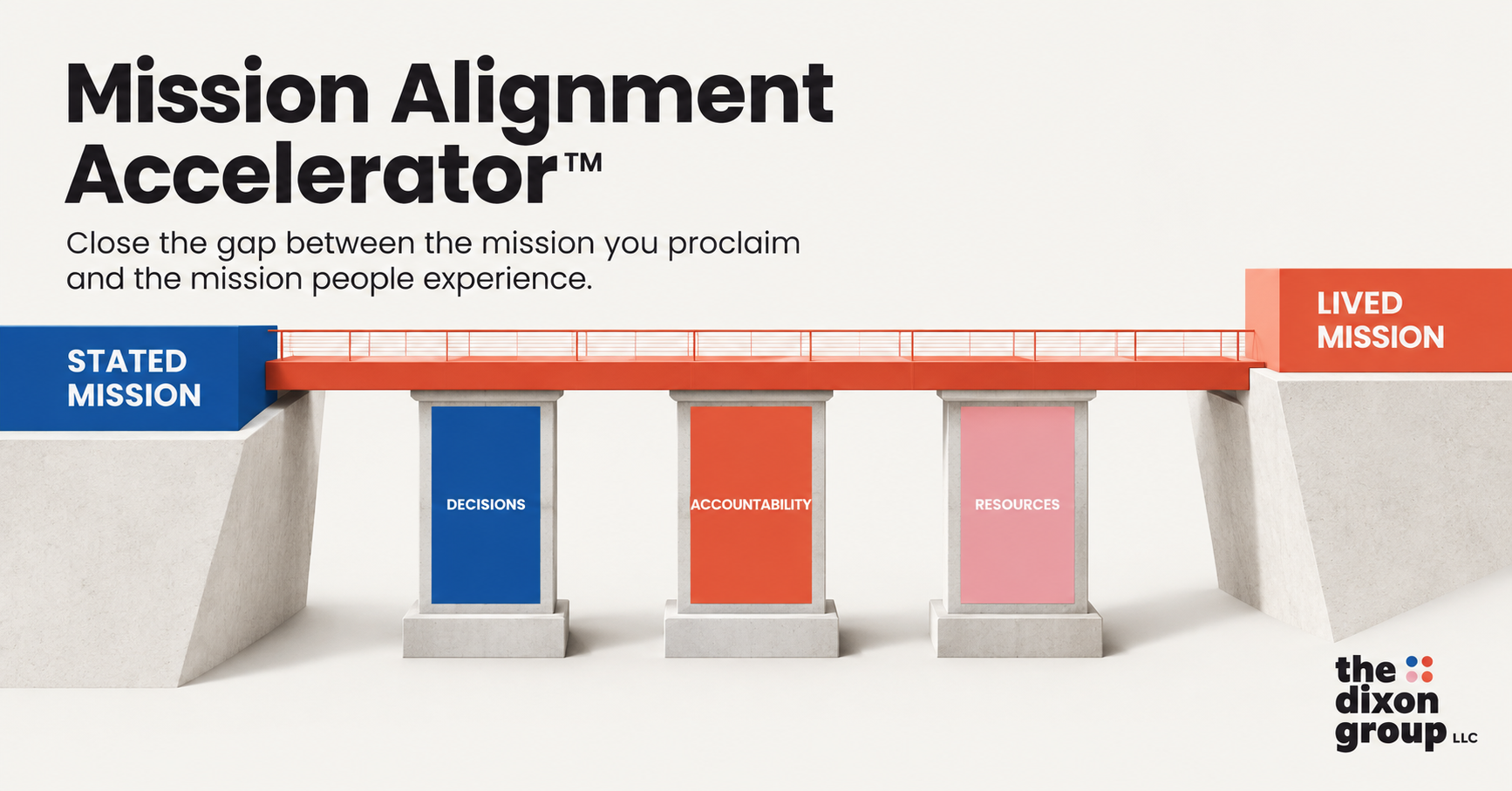
Every organization has two missions: the mission it proclaims and the mission people experience. When those missions diverge, a Mission Credibility Gap™ emerges. Employees begin to question leadership. Stakeholders lose confidence. Donors may reconsider their commitment. Culture weakens, and strategic execution becomes harder.
The Mission Alignment Accelerator™ is The Dixon Group’s flagship advisory engagement for leadership teams ready to close that gap. It moves organizations beyond mission language and into measurable leadership consistency.
The engagement follows eight integrated components:
Executive discovery to identify the organization’s mission credibility hypothesis.
Employee and stakeholder listening to surface hidden inconsistencies and institutional blind spots.
A Mission Alignment Index™ baseline scorecard to establish a practical starting point for measurement.
A Leadership Mission Consistency Framework™ workshop focused on three pillars:
Decision Alignment: Are decisions made through clear mission criteria?
Accountability Alignment: Are leaders evaluated on mission outcomes?
Resource Alignment: Do budgets and investments reflect mission priorities?
Alignment redesign to strengthen decision-making, accountability, and resource allocation.
Ninety-day (90) leadership behavior commitments that convert insight into visible action.
A measurement dashboard and progress review to track movement and reinforce accountability.
Sustainment and advisory support to embed consistency beyond the initial engagement.
The goal is not a better mission statement. It is a leadership system in which actions, decisions, accountability, and resources consistently support the mission.
The result: stronger employee trust, greater stakeholder confidence, deeper donor commitment, improved organizational alignment, and more disciplined execution.
What is the distance between the mission your leaders proclaim and the mission your people experience?
Closing that distance begins with leadership behavior.
“For which of you, intending to build a tower, sitteth not down first, and counteth the cost…” — Luke 14:28
For more than twenty-five years, I have served the church as a lay pastor, teacher, youth leader, pastor, communicator, and administrator. During those years, I have participated in hundreds of leadership conversations about budgets, public perception, crisis response, and organizational decision-making. While every situation was different, one pattern emerged with remarkable consistency.
Too often, we make decisions based on optics rather than stewardship.
Let me be clear. Optics matter. Perception shapes trust, and trust is one of the most valuable assets any ministry possesses. But there is a significant difference between managing perception and allowing perception to dictate every decision we make.
When optics become the primary decision-maker, stewardship often becomes the casualty.
Consider a simple yet serious example. Let me say this bit first: I am not advocating either way, just making an observation. Here we go…
Several years ago, I participated in discussions surrounding a pastors’ and spouses’ retreat. As hospitality costs continued to rise, someone suggested an alternative that, from a purely financial perspective, made perfect sense. A cruise could provide lodging, meals, meeting space, transportation between destinations, and family activities for less than many comparable hotel conferences.
On paper, it was excellent stewardship. Yet the idea never gained traction. Not because it cost more. Not because it provided less value. Not because it failed to accomplish the ministry objectives.
It failed because of one question:
“What will the members think if they hear and see their pastors and families on a cruise?”
The optics defeated the economics.
Leaders contemplated some of the questions members would ask: Why are tithes being used for this trip? What else could those funds support instead of a pastors’ and families’ retreat? Are members really paying for pastoral vacations now? Because financial decisions have so many different aspects, I will let the CFOs and treasurers answer the more detailed part of this concern. However, I will say that pastors are supported by tithes (1 Corinthians 9:13-14), and often the funds for these types of events or meetings are not from tithes.
Ironically, many of those same organizations later approved conferences at expensive hotels, resort properties, or convention centers that ultimately cost considerably more. The difference was not stewardship. The difference was perception. This issue is not limited to one conference or organizational setting; it is precisely where strategic communication can play an indispensable role. More on that shortly.
This is where leadership faces one of its greatest tensions. We often confuse appearances with accountability. The solution is not to choose the option that looks least extravagant. The better approach is to choose the option that best stewards God’s resources, then explain that decision with honesty and transparency. Members are not opposed to pastors having time away with their families or fellow ministry colleagues for rest, bonding, and collaboration; they simply deserve to understand the stewardship behind the decision.
Consider the story of Jesus in the house of Simon the leper (Matthew 26:6–13; Mark 14:3–9). Some questioned whether the value of the gift should have been used for the poor. The moment was not simplistic, but its meaning was clear: it centered on Jesus and on a woman who loved Him deeply and expressed that love through sacrifice. In the same way, when pastors carry the weight of members’ problems, pain, and predicaments, allowing organizations to pour into them and their families can become a meaningful act of care—an echo of Jesus’ words, “Leave her alone. Why are you troubling her?”
This same pattern surfaces in another area that gives me pause.
When organizations experience conflict, allegations, or internal crises, there is often tremendous pressure to resolve the issue quickly. Being a crisis communicator, I agree that the situation should be resolved as soon as possible. However, rather than investing in proactive communication planning, organizational trust-building, mediation, or strategic counsel, some organizations simply calculate the financial cost of making the problem disappear. Disappearing is not transparency; it is organizational and system-wide concealment.
Settlements become communication strategies. Non-disclosure agreements become reputation management. Silence becomes the preferred message. The immediate crisis may fade from public view, but the underlying issue rarely goes away. It often resurfaces later, sometimes under new leadership and with greater force, because the organization treated communication as a cost to avoid rather than an investment in trust.
Strategic communication is not damage control. It is organizational stewardship. Here we go!
Professional communicators do far more than write press releases or manage social media accounts. At their best, they help organizations identify risks before they become crises. They ask difficult questions. They evaluate stakeholder and audience expectations. They help leaders explain difficult decisions before others explain those decisions for them. Most importantly, they help organizations preserve trust. Trust is always less expensive to maintain than it is to rebuild.
Unfortunately, communication professionals are often invited into the room after the decision has already been made. Leadership asks them to “fix the optics” instead of allowing them to help shape better decisions from the beginning. That is backward. Communication should not be the paint applied after construction is complete. It should be part of the architectural blueprint.
The church, perhaps more than any other organization, should understand this principle.
Scripture consistently calls God’s people to faithful stewardship, not impressive appearances. Jesus repeatedly challenged religious leaders who mastered appearances while neglecting justice, mercy, and faithfulness. He never condemned wise planning. He condemned hypocrisy.
Transparency often solves what secrecy attempts to hide. Imagine if leadership simply explained the reasoning behind a difficult decision.
“We evaluated five different venues. This option reduced our overall costs by thirty percent, included all meals, eliminated transportation expenses, and allowed pastors and their families to spend uninterrupted time together for renewal. We chose this option because we believe faithful stewardship requires us to maximize ministry while minimizing unnecessary expense.”
That conversation looks very different from one that allows members to discover photos online and form their own conclusions. The problem was never the cruise. Many of the members have probably enjoyed cruising for years. The problem for church leadership was the absence of communication.
Good stewardship and good communication are not competing values. They are partners.
Perhaps the greater question for Christian organizations is not, “How will this look?” Perhaps we should first ask, “Is this the wisest use of the resources God has entrusted to us?”
Then we ask a second question:
“How do we communicate this decision in a way that builds trust rather than suspicion?”
Optics matter. But stewardship matters more. And when stewardship is paired with transparency, the optics often take care of themselves.
A Call to Faithful Stewardship
For leaders, the call is to make decisions rooted in stewardship, courage, and transparency—not fear of misunderstanding. Count the cost, but count it honestly. Invite communicators into the process early, not merely to explain decisions later, but to help shape decisions that can withstand scrutiny and build trust.
For communication professionals, the call is to speak with clarity, conviction, and strategic wisdom. Do not settle for managing optics when the deeper work is strengthening trust. Ask the difficult questions. Advocate for transparency. Help the organization tell the truth before silence tells a different story.
For members, the call is to extend both accountability and grace. Ask thoughtful questions, seek understanding, and expect responsible stewardship—but also recognize that ministry leaders and their families need renewal, care, and support. A healthy church does not choose between care and accountability; it practices both.
If we are serious about mission, we must be equally serious about the trust that sustains it. Let us stop allowing optics to lead where stewardship should guide. Let us communicate clearly, decide faithfully, and steward God’s resources in ways that are both wise and worthy of the people we serve.
Before I began my journey toward Accreditation in Public Relations, I was a tactician.
If leadership asked for a video, I created a video. If they needed a social media post, I drafted one. If there was an announcement, campaign, or event to promote, I got to work. I took pride in being responsive, creative, and dependable.
But I did not always ask the questions that should come before the work.
Why are we doing this? Who are we trying to reach? What do they need from us? What outcome are we trying to achieve? And how will we know whether it worked?
Too often, success was measured by a few likes, positive comments, or the feeling that we had “gotten the word out.” At the time, that felt sufficient. Looking back, I can see that I was focused on outputs rather than outcomes. I was producing communication, but I was not always practicing public relations strategically.
Then, a seasoned APR professional, Patti Conwell, APR, challenged me to pursue accreditation. My first reaction was not gratitude. It was anger.
I believed I already knew how to be a strategic thought partner to leadership. I had experience, good instincts, and a deep commitment to my organization. Her suggestion felt like a critique of my capabilities. But beneath that challenge was a deeper question: Did I know public relations as well as I possibly could at that point in my career?
That question stayed with me. Eventually, it became the beginning of my APR journey.
As I started the process, I discovered that APR was not about dismissing the experience I already had. It was about giving that experience a stronger framework. It opened a new way of thinking and challenged assumptions I did not even realize I was making.
I began to understand that public relations is not simply creating a message and pushing it out (tactician). It is a disciplined process of research, planning, implementation, and evaluation (RPIE). It means understanding the organization’s goals and objectives before deciding which tactics will support them. It means identifying the right audiences, listening deliberately, setting measurable objectives, and evaluating whether the work made a difference.
That process strengthened my ability to offer trusted counsel.
It helped me move from being someone asked to “make something” to someone who could respectfully push back and ask why. Why is this our goal? Why is this our audience? Why is this the right approach? What evidence supports this decision? What will success look like? Those questions do not make a communicator feel difficult. They make a communicator strategic.
APR also changed how I viewed audiences. They were no longer simply groups to communicate to or targets for a message. They were people, individuals with perspectives, concerns, experiences, and needs. My responsibility was not merely to reach them. It was to listen to them, learn from them, and build relationships grounded in trust.
That distinction matters. Public relations cannot be a one-way monologue. It must be a two-way conversation. We have to make room for feedback, even when it is uncomfortable. We have to understand what people are telling us, not just what we hope they hear from us. And we have to recognize that meaningful communication is built through relationship, not just reach.
Pursuing APR also required vulnerability. To build an effective strategic plan, I had to ask leaders and stakeholders to trust me with their candor—their concerns, priorities, and sometimes difficult realities. That kind of strategic work requires strong relationships and the credibility to be in the room when decisions are being made.
It also requires leadership to believe that you can help advance the organization’s goals while protecting the organization and its leaders when it matters most. That trust is not automatically given because someone has a communications title. It is earned through preparation, sound judgment, listening, integrity, and the willingness to provide honest counsel.
Life before APR was not a failure. It was an important part of my professional foundation. But life after APR is more intentional. I now approach public relations with a deeper understanding of strategy, measurement, ethics, relationships, and responsibility.
APR did not erase my experience or tell me I was not capable. It gave my experience a stronger framework, a sharper purpose, and the confidence to ask better questions.
If you are curious about what a more intentional, strategic, and relationship-centered practice of public relations could look like, let that curiosity lead you. You do not need to have every answer before you begin the APR journey. You simply have to be willing to grow.
You spend most of your time in meetings that could have been emails, answering emails that could have been automations, and doing tasks that should have been delegated years ago. Good news: AI can fix that—without turning your organization into a sci-fi movie.
Workflow stacking is the secret. Instead of using one AI tool at a time, you connect them to streamline your processes.
For example:
Record your meeting with a transcription tool.
Feed the transcript into an AI summarizer.
Turn the summary into action items.
Convert those action items into a blog post or social content.
Schedule the content automatically.
A one-hour meeting becomes a week of communication material.
Use AI to create donor thank-you notes, internal memos, content calendars, or policy drafts. Use it to shorten long paragraphs, rewrite confusing messages, or outline training modules.
When leaders adopt workflow automation, they finally get time back to think about strategy—not just survival.
You won’t reach a four-hour workweek, but you will work smarter, faster, and with fewer headaches.
AI is not here to take your job. It’s here to take your busywork. The sooner leaders embrace that, the sooner they reclaim their time and sanity.
Think of AI as the unpaid intern you always wanted—one who doesn’t sleep, never complains, and somehow knows every file on your computer. Use it for administrative tasks, not relationship work. It can draft emails, summarize meetings, outline grant proposals, or help brainstorm content. It cannot replace your leadership, empathy, or expertise.
Start with five simple tools: • AI writing assistants • Social media scheduling automation • Automated donor nurture sequences • Voice-to-text meeting recorders • AI-driven analytics dashboards
Don’t overcomplicate things. Pick one task you hate doing and let AI handle it. That alone will change your life.
And no, you don’t need to become a tech expert. You just need a willingness to experiment. Leaders who ignore AI will fall behind the ones who embrace it.
Organizations don’t fail because of bad intentions—they fail because they stop adapting. The phrase “We’ve always done it this way” is the unofficial battle cry of stagnation.
Agility begins with honesty. Audit your programs annually. What still works? What’s outdated? What drains time and money without producing impact? These “zombie projects” must go. Leaders must be brave enough to stop what no longer serves the mission.
Next, test new approaches in small ways. You don’t need to launch a massive new program to innovate. Try a digital campaign, a short-term pilot, or a micro-event. Innovation is less about grand gestures and more about ongoing curiosity.
Embrace rapid learning. Not every idea will succeed—and that’s the point. Fast feedback beats long-term mediocrity.
Communication must evolve too. Your audience expects instant information, modern visuals, and relatable messaging. If your brand feels like a time capsule from the early 2000s, you’re losing credibility before you say a word.
The world moves fast. You don’t need to be trendy, but you must be responsive, flexible, and open to change.