
REFLECTIVE CASE STUDY
A first-person reflection on belonging, race, institutional hospitality, and social justice leadership
Dr. Kenn Dixon, LSSGB, APR
Pastor, Communicator, Marine, and advocate for a church that practices welcome
THE CENTRAL QUESTION
What does a church reveal about its theology when a stranger reaches its door and is redirected before he is known?
Based on the sermon manuscript “Still Standing at the Door” shared in 2020.
Executive Reflection
I went looking for a church because I needed strength. I had received orders to report to Jacksonville, North Carolina, for my assignment at Camp Lejeune with Second Battalion, Sixth Marines, Second Marine Division. I was entering a demanding chapter of military life, and I wanted a congregation that could help steady my spirit for the road ahead.
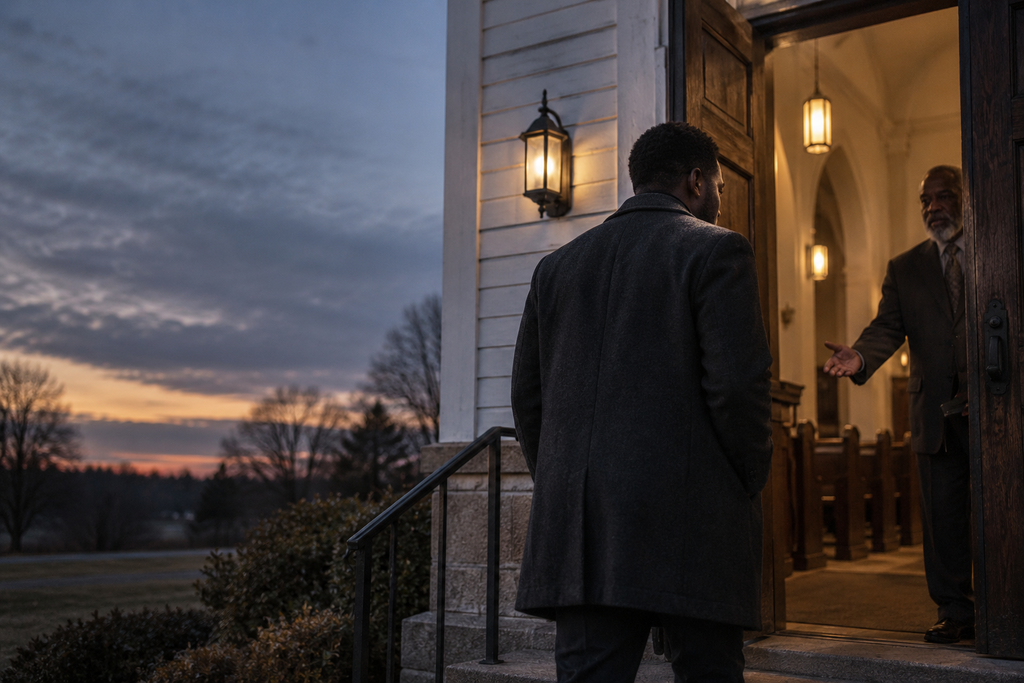
On a Wednesday night, I found a small church just off the main road into downtown Jacksonville. I approached the door expecting that the first question might be my name. Instead, an elder greeted me with a conclusion: “You are probably looking for the other church on the other side of town.”
The sentence was polite enough to be denied and clear enough to be understood. No one had asked why I came. No one had asked whether I was new to the area, whether I was a Marine, whether I needed prayer, or whether I belonged to the body of Christ. Before I crossed the threshold, I had been assigned somewhere else.
At the time, I experienced the moment as rejection. I now understand it as more than an unkind exchange between two people. It was a case of institutional hospitality failing at the point where theology becomes behavior. It exposed the distance between saying that all are welcome and preparing a community to welcome the person it did not expect.
The story did not end with that elder. Another elder overheard the comment, drew me into an office, and prayed with me. I later found the church across town and was welcomed there. I started a youth group with about ten young people. Parents connected to the first church heard about the group and asked me to include their youth. We eventually held a youth day at that first church. Months later, when the elder who had shown me kindness died, I was invited to speak at his funeral. I told the congregation that his welcome had represented Jesus to me.
That whole arc matters. Exclusion was real. So were intervention, relationship, and repair. Together, those experiences helped shape my social-justice preaching and my leadership conviction that belonging cannot be left to chance.
What Happened at the Door
A church door is never just a door. It is a threshold between what an institution says about itself and what a newcomer experiences. Websites, signs, sermons, and mission statements may declare welcome, but the person stationed at the threshold interprets the institution in real time.
I cannot prove what was in the first elder’s heart, and I do not need to. Leadership must take impact seriously even when intent is disputed. The effect of his words was to tell me that someone like me had an expected place, and it was not there. The racial meaning was not stated directly, but I found it unmistakable. The direction to the other church across town carried a history larger than that Wednesday night. It says, “Your place is across the tracks, not here.”
The Immediate Interpretation
In that moment, I understood the encounter personally. I had come for spiritual support and met social distance. The pain was sharpened by the setting. Rejection at a store or workplace can wound; rejection at a church door reaches into a person’s understanding of God, community, and worth. The institution that should have made room seemed to be protecting a boundary. I recognize now, especially as a pastor, that “we wrestle not against flesh and blood, but against principalities, against powers, against the rulers of darkness of this age” (Ephesians 6:12). Still, as a Marine seeking spiritual help while my faith was being tested, this was not the response I needed.
The Interpretation I Carry Now
With time, I learned to read the moment systemically. The elder’s statement was an individual act, but it was also evidence of a learned map: this person belongs there, our people belong here, and the arrangement need not be named to be enforced. Institutions reproduce such maps when leaders leave hospitality undefined, untrained, and unexamined.
The Case Through Six Lenses
| Moment | What I felt then | What I see now | Leadership meaning |
| Approaching the church | Hopeful and spiritually hungry | A newcomer testing whether the institution’s welcome is real | Every threshold communicates belonging before a sermon begins |
| Being redirected | Surprised, rejected, and racially assigned | Coded exclusion operating through an ordinary sentence | Impact must be addressed even when intent is contested |
| The second elder intervenes | Seen, comforted, and prayed for | A bystander choosing to interrupt the harm | Culture changes when witnesses become responsible actors |
| The other church welcomes me | Received and able to serve | Belonging releasing gifts that exclusion could have buried | Hospitality is not courtesy alone it is ministry capacity |
| Youth ministry crosses the divide | Trusted by families from both communities | Relationship disrupting an inherited boundary | Shared mission can create repair when truth is not erased |
| Speaking at the funeral | Grateful for the elder’s kindness and will be missed | A chance to name the welcome I wanted the church to reproduce | Honor and accountability can inhabit the same story |
Race and Institutional Hospitality
Race often operates through arrangements that appear normal to those who benefit from them. No sign has to say that a person is unwelcome. A look, a pause, a referral, a seating pattern, a leadership pipeline, or a phrase such as “the other church” can carry the message. The language may remain indirect while the boundary remains effective.
That is why hospitality cannot be measured by whether regular members feel friendly. Members already know the codes, relationships, and expectations. The real test is the experience of the person without social protection: the visitor, the young person, the racial minority, the immigrant, the poor family, the person with a disability, the individual whose clothing or history does not match the room.
Institutional hospitality asks a harder question than whether we opened the building. It asks whether people can enter without surrendering their dignity. It asks whether their gifts are recognized, whether their needs are heard, and whether they can move from visitor to participant to leader.
How the Experience Changed My Preaching
The encounter helped me see that social justice is not an optional department of the gospel. It is a test of whether the gospel has reached our habits. My sermon placed the church door alongside Revelation 3:20, where Jesus stands outside and knocks, and Matthew 25, where judgment turns on how we treat people who are hungry, thirsty, estranged, exposed, sick, or imprisoned.
Those passages would not allow me to treat exclusion as a public relations problem. The issue was spiritual. A church can defend correct teachings, maintain respected programs, and still leave Christ standing outside in the person it does not welcome. It can perform religious activity while avoiding the neighbor whose presence makes the congregation uncomfortable.
This conviction gave my preaching a sharper edge. I became less willing to accept “let us not get political” as a reason to avoid racism, disenfranchisement, suffering, or preventable harm. I learned to ask whether our silence protected people or merely protected the status quo. Justice may be represented as blind, but it is not deaf. It hears the cry at the door.
How the Experience Changed My Leadership
I did not leave Jacksonville believing that one painful encounter defined every person in the first church. The second elder’s intervention prevented that simplification. His prayer showed me what responsible presence looks like: he noticed, he moved toward the person who had been harmed, and he used his influence to create a different experience.
That response became a leadership standard. When exclusion occurs, neutrality is not hospitality. A leader or member who witnesses harm must make a decision. Silence leaves the original message in place. Intervention tells the excluded person and the institution that another way is possible.
Five Practices I Carried Forward
Design the welcome. Do not depend on personality or goodwill alone. Define how visitors are greeted, introduced, assisted, and invited into relationship.
Train the threshold. The people answering doors, phones, email, registration tables, and social messages carry institutional authority whether leaders recognize it or not.
Listen to impact. Do not make an excluded person prove another person’s intent before taking the harm seriously.
Equip witnesses to act. Teach members how to interrupt exclusion, attend to the harmed person, document patterns, and involve the right leaders.
Build repair into the culture. Create pathways for truth, apology, changed behavior, shared work, and restored trust without demanding premature reconciliation.
Belonging Releases Capacity
The youth group is evidence of what welcome can release. I arrived needing support, but once I was received, I became able to serve. Roughly ten young people became a ministry community. Families from beyond that congregation recognized the value and asked to participate. The person redirected at one door became a bridge between young people connected to both churches.
That is one of the hidden costs of exclusion: institutions do not merely injure the person outside. They deprive themselves of gifts, relationships, ideas, and future leadership. The church that turns away a stranger may be turning away the very person equipped to help it reach its children and future generations.
A Leadership Test for Belonging
| Leadership area | Question to ask | Evidence to examine |
| Mission | Does our practice of welcome reflect the gospel we proclaim | Stories from newcomers and people at the margins |
| People | Who is redirected, overlooked, or expected to assimilate | Patterns in complaints, participation, and departure |
| Process | Are front-line representatives trained and accountable | Greeting protocols, escalation paths, and leader follow-through |
| Power | Whose voice shapes decisions and defines what feels normal | Leadership representation, agenda access, and speaking time |
| Repair | What happens after harm is reported | Response time, care for the harmed party, accountability, and changed practice |
What I Understand Now
I once thought I was standing outside asking a church to let me in. Revelation helped me see another possibility: Jesus was already standing at the door, identified with the stranger, waiting to see whether the church would recognize Him. The question was not simply whether I could enter. The question was what the church would do with Christ arriving in a form it had already categorized.
I also understand that justice is practiced in ordinary moments. It is not limited to statements after a national tragedy or sermons during an anniversary. Justice appears when someone refuses to let a coded dismissal pass. It appears when a leader makes room, offers prayer, shares power, and changes the system that allowed the injury.
The second elder did not erase the first elder’s words. He showed me that a person inside an imperfect institution can choose a different witness. The later youth ministry did not make the original exclusion acceptable. It demonstrated that relationships can cross a boundary when people are willing to open what fear and habit have kept closed.
Conclusion
I am still knocking at the door because churches, organizations, and leaders are still deciding what belonging will require of them. Some doors are physically open while social doors remain guarded. Some communities welcome people into the room but never into influence. Some leaders speak out against injustice in public while tolerating quiet exclusion in the institution’s everyday life.
My experience at Camp Lejeune taught me to preach and lead at that threshold. I want to notice the person who has been categorized before being known. I want to challenge the sentence that redirects them. I want to honor the witness who intervenes. I want to build ministries in which belonging releases service, leadership, and shared mission.
The measure of hospitality is not how warmly we greet the people we expected. It is what happens when someone we did not expect shows up at the door. In that moment, our theology becomes visible. We either reinforce the boundary or open the way home.
Source Note
Primary source. Kenn Dixon, “Still Standing at the Door,” unpublished sermon manuscript based on Revelation 3:20–21 and Matthew 25:31–46. The uploaded manuscript supplies the Camp Lejeune encounter, the second elder’s prayer, the welcoming congregation, the youth group of about ten participants, the later youth day, the elder’s funeral, and the sermon’s theological emphasis on justice, hospitality, and care for those in need.
Editorial note. This case study uses the requested title “Still Knocking at the Door.” It presents the racial meaning of the encounter as Kenn Dixon’s first-person interpretation and does not claim access to the first elder’s private intent or add facts about either congregation’s racial composition.